

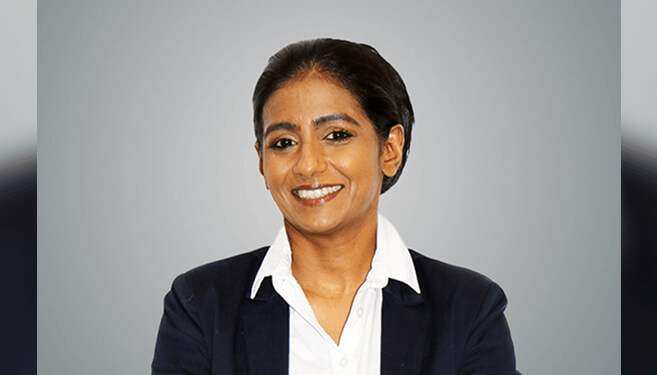
Framed by a career shaped in complex, male-dominated industries and a deep awareness of governance gaps, Dr Judy Gounden pursued research that would ultimately earn her a Doctor of Business Administration (DBA) from the Graduate School of Business and Leadership at the University of KwaZulu-Natal (UKZN).
“Pursuing the DBA allowed me to combine my practical experience with rigorous academic inquiry to contribute new knowledge, particularly around women’s board leadership development, an area with limited longitudinal research in South Africa,” said Gounden.
Her doctoral study examined the development of women in board leadership, focusing on lived experiences rather than representation alone. Drawing on insights from 17 women board members certified through the Institute of Directors South Africa (IoDSA), the research explored how leadership capability is shaped over time through resilience, identity formation, organisational culture, and exposure to governance structures. Her study emphasised the importance of lived experience in understanding leadership barriers and opportunities.
Gounden’s research was informed by her own professional journey, which began in engineering and instrumentation before evolving into executive leadership across mining, construction, petrochemicals, retail and cybersecurity. At the time of completing her doctorate, she was serving as Chief Executive Officer of Quantum PKI, a global cybersecurity and digital trust firm, where she led strategy at the intersection of technology, governance and innovation.
“Having personally navigated senior leadership spaces, I understood the need for research that captures women’s real-world experiences and not just statistics to inform policy, leadership programmes, and organisational transformation. My goal was to create a meaningful contribution that supports gender equity and strengthens corporate governance,” she said.
The study found that women’s leadership trajectories are not linear but shaped by layered experiences that require both adaptability and agency. Participants described a shift from technical expertise to strategic oversight, from operational contribution to ethical stewardship, and from navigating boardroom dynamics to actively shaping them. These transitions underscored the complex capabilities required for effective governance in contemporary organisations.
A key outcome of the research was the development of an integrative framework for women’s board leadership, identifying critical enablers including strategic capability, ethical governance, resilience, identity development, mentorship and sponsorship, and the ability to exercise influence within board structures. The study further highlighted the importance of support systems such as mentoring and coaching in accelerating women’s progression into senior roles.
Gounden undertook her doctoral studies while maintaining an executive leadership role, navigating the demands of research alongside professional responsibilities. This required discipline, structured time management and reliance on support networks, an experience that mirrored the resilience themes emerging from her study.
She described her doctoral journey as both intellectually demanding and personally affirming, enabling her to contribute meaningfully to the body of knowledge on leadership and governance while reinforcing her commitment to inclusive and ethical boardrooms.
Her research aims to inform leadership development programmes, governance training, and policy interventions that advance gender equity in South Africa. She plans to extend the impact of her work through collaboration with institutions, regulators and board networks.
“I plan to contribute further to board advisory work, support women leaders through mentoring, and engage in policy and thought leadership conversations that promote gender inclusive governance,” said Gounden.
She was grateful for the support received from her supervisors, mentors and professional network throughout her academic journey.
Her achievement reflects UKZN’s ongoing commitment to producing graduates whose research addresses real-world challenges and contributes to societal and organisational transformation.
Words: Lungile Ngubelanga
Photograph: Supplied