

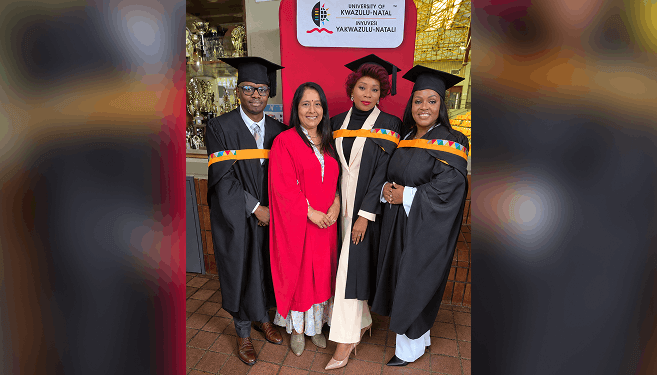
For Dr Andrisha Beharry-Ramraj of the School of Commerce at the University of KwaZulu-Natal (UKZN), celebrating the graduation of three Master of Commerce in Management students was a deeply rewarding occasion that highlighted her dedication to student achievement.
The students were: Mr Mzokhanyayo Cebekhulu, Ms Cherity Ngcamu and Ms Sarah Njapha.
“Seeing three of my students successfully reach graduation was particularly meaningful because each student faced their own unique challenges and journey,” said Beharry-Ramraj. “Through regular engagement, academic guidance, and perseverance, we were able to navigate the research process together and achieve the desired outcome. For me, supervision is not simply about getting students to the finish line, it is about developing independent researchers who can contribute meaningful knowledge to their fields.”
Cebekhulu’s dissertation was titled: ‘Analysing the Impact of Change Management Post-Coronavirus in the Public Sector: A Case Study of the Department of Economic Development, Tourism and Environmental Affairs in KwaZulu-Natal’.
Reflecting on his journey, Cebekhulu said: “I am especially grateful that Dr Beharry-Ramraj believed in my research idea and helped me strengthen it without asking me to change it. Her unwavering support, encouragement and guidance sustained me throughout my research journey and kept me going during the moments when I felt like giving up.”
Ngcamu’s dissertation focused on: ‘The Impact of Management Development on Community Engagement: A Case Study of the Kwa Xolo District’. The study explored how effective management development can strengthen community participation and contribute to sustainable tourism development.
Said Ngcamu: “The journey was challenging, particularly in balancing research with my professional responsibilities but my passion for tourism development kept me motivated. I was inspired by the potential of my research to contribute positively to rural communities and create more inclusive tourism opportunities. There were moments when the road was challenging and uncertain, but my supervisor’s encouragement continually reminded me that I could reach the finish line. More than an academic mentor, my supervisor became a source of wisdom, motivation and reassurance.”
Njapha’s dissertation focused on: ‘Assessing the management analysis of employee absenteeism in the workplace: A case study of the University of KwaZulu-Natal Human Resource Division’. The study explored the main causes of absenteeism, its effects on service delivery, the influence of organisational policies, and the strategies in use. This section combined primary data with academic viewpoints to highlight the intricate dynamics influencing attendance behaviours at universities.
“The findings provided a discussion on the direct relationship with the current literature and the conceptual framework regarding employee absenteeism, demonstrating how empirical evidence from universities either aligns with or diverges from established absenteeism theories,” said Njapha.
She added that the guidance she received from her supervisor during her Master’s journey was truly transformative. “From the initial stages of improving my research topic to the final revisions of my dissertation, my supervisor blended intellectual rigour with a sincere commitment to my growth as both a scholar and a professional.”
Words: Thandiwe Jumo
Photograph: Supplied