

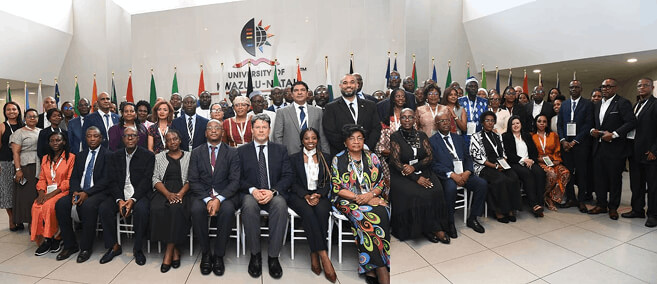
The Public Protector South Africa, in its capacity as Chairperson of the African Ombudsman Research Centre (AORC), has successfully relaunched the Centre at the University of KwaZulu-Natal (UKZN).
This high-level event was convened in partnership with the Department of International Relations and Cooperation (DIRCO), the International Ombudsman Institute (IOI) and UKZN.
Under the theme: ‘Using Ombudsman Powers to Strengthen Governance and Advance SDGs in Africa’, the relaunch included a high-level training programme for ombudsman institutions, Public Protector institutions, policymakers, members of the African Peer Review Mechanism (APRM), academics, and governance experts from across the continent, reaffirming the critical role of oversight institutions in promoting accountability, transparency and ethical governance in Africa.
Launched 15 years ago, the AORC, located at UKZN, has been instrumental in equipping ombudsman institutions across Africa with the knowledge, skills and research needed to support their mandates.
As the research and training arm of the African Ombudsman and Mediators Association (AOMA), the relaunch of the Centre marks a strategic milestone in strengthening collaboration among governance oversight institutions across Africa. It renews the Centre’s commitment to expanding its reach and training programmes.
The Centre’s renewed mandate underscores efforts to empower Ombudsman and Public Protector institutions to advance transparency, ethical governance and administrative justice – crucial at a time when many African states face rising pressure to tackle corruption, promote whistleblower protection and rebuild public trust. In short, it marks a strategic and symbolic recommitment to building stronger, more accountable and citizen-responsive governance systems across Africa.
Importantly, the research and training programmes will help support the statutory mandates of oversight institutions, strengthen their investigative and oversight powers in the implementation of Agenda 2063 and the Sustainable Development Goals (SDG’s). It will also monitor service delivery outcomes aligned to the SDGs.
Delivering the keynote address, Deputy Minister of Justice and Constitutional Development, Mr Andries Nel, said, “Ombudsman, Mediators and Public Protector institutions play a crucial role in advancing Agenda 2063 and the United Nations’ Sustainable Development Goals, particularly SDG 16, which promotes peace, justice, and strong institutions.”
He further highlighted the importance of recent systemic investigations that have contributed to strengthening human rights protections for vulnerable groups, particularly in addressing gender-based violence and femicide, which have been declared a national crisis in South Africa.
Professor Anil Chuturgoon, UKZN’s Acting Deputy Vice-Chancellor for Research and Innovation, said: “The relaunch of the African Ombudsman Research Centre reflects a shared commitment from all of us, as partners, to strengthening accountability, deepening democratic practice, and ensuring that public institutions remain responsive to the people they serve. Across the continent, ombudsman institutions carry a vital responsibility.”
“As a proudly African university committed to research that responds to real challenges and learning shaped by the realities of our continent, this gathering reflects who we are and what we stand for. Here at UKZN, we believe that knowledge must find expression in institutions, policies and practices that improve lives. The Africa Ombudsman Research Centre, within our School of Law, embodies this approach,” he said.
South Africa’s Public Protector and African Ombudsman Research Centre Board Chairperson, Advocate Kholeka Gcaleka, said South Africa is proud to play a pivotal role in this initiative and to share its experiences in advancing democratisation across the continent. She added that this shared experience will empower African citizens to hold their governments accountable.
She further revealed that AORC has submitted a draft resolution to the Department of International Relations and Cooperation (DIRCO) for consideration and tabling at the African Union Commission. “Ombudsman institutions must position themselves as champions of good governance on the continent,” she said.
Words: NdabaOnline
Photograph: Supplied