

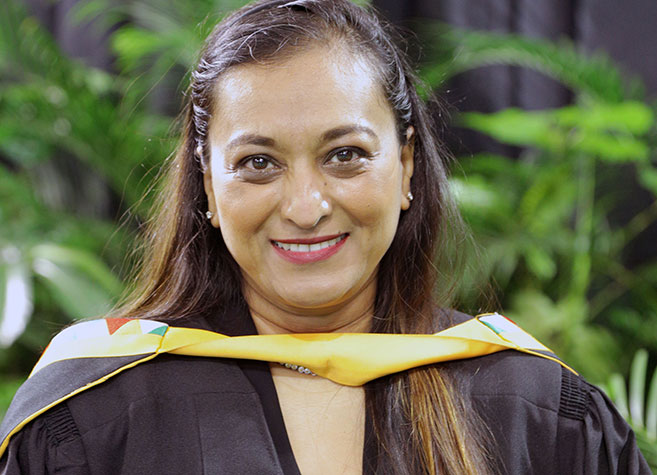
Concerned about the high number of criminals re-offending, Advocate Sabera Khan embarked on a research study which investigated the efficacy of programmes and strategies to reintegrate former prisoners into the economy and society for which she was awarded a Master of Laws in Criminal Justice by UKZN in May.
Khan’s study was supervised by UKZN’s Criminal Justice expert Professor Managay Reddi.
With the National Institute for Crime Prevention and the Reintegration of Offenders (NICRO) attributing the high recidivistic behaviour of criminals to poor rehabilitation and reintegration programmes from the justice system which negatively impacts the safety of the public, Khan examined sentencing options and community correction that endorse former prisoner reintegration into the society.
She said that international studies have revealed that reduced recidivism is linked to the implementation of alternative sentencing options, improved access to employment and social acceptance of former prisoners which requires the implementation of the principle of restorative justice, non-custodial sentences and prisoner empowerment.
Having worked in the criminal justice space for more than 20 years, Khan has represented many accused in their criminal cases and has had the opportunity to sit as an assessor with the presiding judges in high court criminal cases. Over the years she observed that many former prisoners were repeat offenders.
She acknowledged that while various interventions have been made such as changing the name “prisons” to “correctional centres”, the criminal justice system seems to be struggling to implement programmes and to encourage a mind-set that release from a correctional centre implies that the former prisoner is rehabilitated and as such ought to have smooth reintegration into the economy and society. ‘I believe that failure to reintegrate a former prisoner means that the punishment never really ends, even when the official sentence is over. Once people have paid their debt to society, they ought to have a fresh start,’ she added.
The study recommends that in order to curb reoffending, improve public safety, reduce the burden on state resources and instil a sense of worth in former prisoners, offenders must be assisted with a state grant and early clearance of criminal records from the National Criminal Register which could improve their access to employment.
It notes the gaps that exist in current legislation and policies which have proven inadequate to sustain the reintegration of former prisoners. Khan hopes it will inform policymakers and correctional services officers of the nexus between sentencing, correctional education and social acceptance of former prisoners and recidivism.
Speaking of her former student, Reddi praised Khan who passed her mini-dissertation with distinction, for her determined pursuit of academic excellence in the midst of holding down her demanding job with the NPA. ‘Sabera was an excellent student who was keen to be guided and challenged during my supervision of her,’ said Reddi. According to Reddi, Khan’s research is innovative and relevant and contains recommendations that have the potential to significantly improve our Criminal Justice System if adopted.
Khan is a senior state advocate in the Asset Forfeiture Unit of the National Prosecuting Authority, South Africa where she is responsible for combating organised crime and money laundering. She holds a Bachelor of Arts (Law) and a Bachelor of Laws from the erstwhile University of Durban-Westville, now UKZN; a certificate in Islamic Law from UKZN and a Master of Business Administration from North-West University. She said that her newly acquired LLM has contributed to her development of expert knowledge of South African Criminal Law and the functioning of the International Criminal Courts ‘This course assisted by upskilling me with the latest research methods,’ she added.
Khan’s ongoing quest to acquire new knowledge and professional development at the age of 50 has motivated her children to follow suit. Her daughter Ms Jameela Sona Ally also graduated at UKZN with a Bachelor of Architectural Studies. On her achievement she said: ‘From a very young age I was encouraged to learn to be self-sufficient and never to allow my disadvantaged background to stop me from pursuing my dreams. My late elder brother always said that an independent woman lives true to her own values and can never be controlled or manipulated to do otherwise. She owns her own power. I owe all my academic achievements to him.’
Words: Hazel Langa
Photograph: Abhi Indarajan