

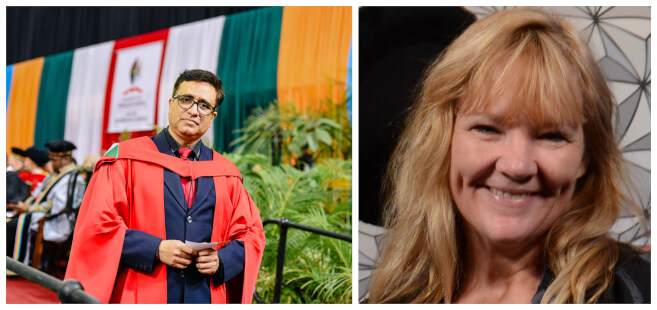
PhD in Management graduate, Dr Paula Hall and PhD in Information Systems and Technology graduate Dr Deepak Kumar’s research explored artificial intelligence (AI) from a gender bias and digital forensics perspective.
Titled: Exploring the Effects of Women in Artificial Intelligence Networks (WAINs) on Women’s Careers in Artificial Intelligence, Hall’s study, which was supervised by Professor Debbie Ellis investigated how WAINs promote women’s careers in AI. It found that the social support, opportunities and resources provided by WAINs contribute to women persisting and advancing in AI careers.
‘Supporting WAINs can improve gender diversity in AI development teams by providing career-enhancing resources and support, benefiting businesses, policymakers, WAIN organisers and women in AI,’ said Hall.
As a digital teaching and learning specialist and lecturer, Hall is passionate about AI and mitigating gender bias in this male-dominated field. According to the United Nations Women 2023 Global Gender Gap Report, women make up only 30% of the global AI workforce.
‘I joined and volunteered in various international events and associations and met some amazing researchers and AI practitioners who were invaluable to my progress. The topic of AI has sprung to the forefront of society and coffee room conversations, so I feel I was ahead of the curve in my topic and the potential problems of bias in AI solutions for society,’ she added.
Kumar’s study titled: The Design and Development of an AI Based Digital Forensic Protocol for First Responders was supervised by Professor Prabhakar Rontala Subramaniam. It aimed to design and develop such a forensic protocol by investigating the challenges faced by first responders in the field of digital forensics.
‘The protocol was fully design science research where I developed AI based algorithms and a prototype to test them for predictive modelling of cybercrime dataset. It specifically focuses on 4IR technologies and AI integration can assist first responders and cybercrime investigators to utilise AI and Machine Learning Techniques to perform “triaging” and quick decision making. The customised AI models were effective in predictive modelling of cybercrime data and image analysis,’ said Kumar.
As an IT specialist and lecturer at UKZN’s School of Management, Information Technology and Governance, Kumar is motivated by research and keeping abreast in cutting-edge technology hence, he took an ambitious step in picking a research topic in digital forensics and AI despite never teaching these topics.
‘This research topic was very new to me but I took the challenge and finally achieved it! My thesis went through multiple iterations as my supervisor wanted the best out of me. Also, it gives you euphoria to make something work for the first time like implementing AI and machine learning (ML) algorithm models and achieving better efficacy with the models. My discipline is also very excited and appreciative of my research as it will allow us to venture into the domain of 4IR and AI for our modules,’ said Kumar.
Words: Thandiwe Jumo
Photographs: Sethu Dlamini and supplied