

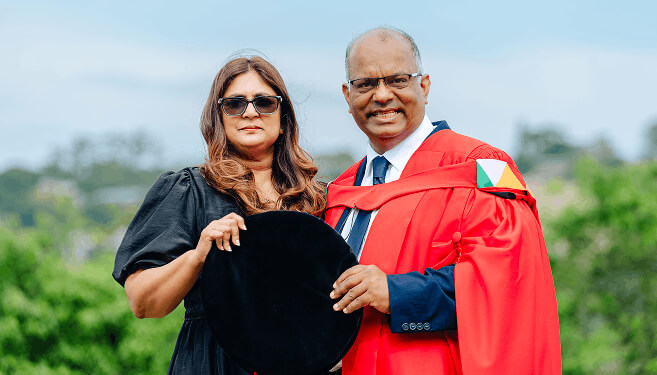
Managing Director at Smiths Manufacturing, Dr Selvin Konar, completed his Doctor of Business Administration (DBA) from the University of KwaZulu-Natal (UKZN) in September 2026.
Konar who has worked in the automotive industry for 35 years said his research was inspired by the dramatic changes in the global automotive sector which included the implications of new energy vehicles (NEVs) and battery-powered electric vehicles for South Africa’s automotive manufacturing ecosystem and its associated companies.
His thesis, titled: ‘A Phenomenological Approach to Advancing Digital Technology Transformation within the Metair Group Considering New Energy Vehicles’, explored how a listed company could prepare effectively for the digital shift while navigating the transition to New Energy Vehicles (NEVs).
Konar said his interest in the topic was driven by its strategic importance and its relevance to the future of Africa’s automotive industry.
“I was particularly interested in exploring how these changes may affect Metair’s operations, competitiveness, and long-term sustainability within South Africa, across Africa, and in key export markets,” he said.
Konar said the research had provided him an opportunity to examine a highly relevant issue critical for the future of the automotive and broader manufacturing sectors.
The DBA also builds on an academic journey that began in 2012 when Konar completed his Master of Business Administration dissertation at the UKZN Graduate School of Business and Leadership (GSB&L), titled: ‘The Impact of the Motor Industry Development Programme on the Automotive Component Industry’.
Konar’s recent doctoral research was supervised by Dr Simon Taylor and Professor Cecile Proches and highlighted the importance of leadership capability and workforce readiness as digital technologies, automation and electrification transform the industry. The study also showed how leaders needed to become more agile, forward-looking and capable of creating organisational cultures capable of embracing innovation and continuous learning.
“Leaders must be able to articulate a clear vision for the future and foster a culture that embraces innovation, continuous learning and change,” Konar said.
He said technological transformation would not succeed without investment in people. “Organisations will need to attract new technical capabilities while simultaneously upskilling and reskilling existing employees to make sure the workforce remains relevant in a rapidly changing environment.”
Konar said his doctorate had fulfilled a long-held personal ambition and reinforced the value of lifelong learning, resilience and adaptability – qualities that had also shaped his leadership journey.
He said the doctoral studies had influenced his leadership philosophy, strengthening his belief in proactive, evidence-based decision-making and the importance of remaining informed about emerging trends.
He added that the unexpected disruptions during his studies had reinforced the importance of resilience and organisational agility as balancing his academic programme with the demands of leading a major manufacturing organisation had required discipline and perseverance.
Konar expressed gratitude to his family and colleagues for their unwavering support during what he described as an arduous but rewarding journey.
The Executive Dean of the GSB&L, Professor Serestina Viriri, commended Konar for tackling an important and timely issue, saying the future success of the automotive sector had significant implications for safeguarding employment, sustaining investment, maintaining export competitiveness and making sure South Africa remained a key participant in the global automotive industry.
Words: Hazel Langa
Photograph: Sethu Dlamini