

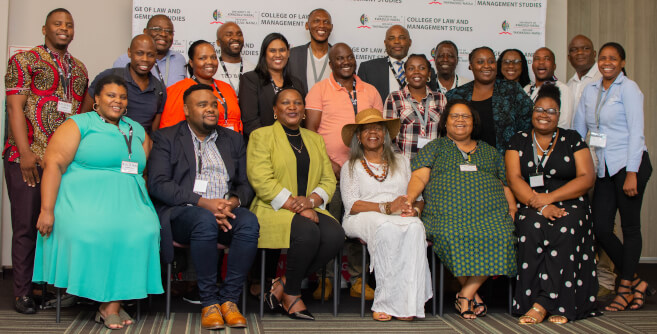
The symposium titled: Strengthening Rural Institutions for Resilient Rural Livelihoods, organised by the NRF/SARChI Chair in Sustainable Rural Livelihoods based in UKZN’s College of Law and Management Studies, was a resounding success.
It was the first symposium held under the auspices of the Research Chair and set the bar high for interdisciplinary, interinstitutional and cross-country dialogue and collaboration.
The symposium, hosted by the National Research Foundation/South African Research Chairs Initiative (NRF/SARChI) Chair in Rural Livelihoods Professor Betty Mubangizi, aimed to foster discussions on enhancing service delivery in rural municipalities, acknowledging excellence in rural regions and building strong interdisciplinary, inter-institutional and cross-country research partnerships. It served as a vital platform for scholars, policymakers, NGOs, and stakeholders to exchange insights, findings, and best practices.
The event featured an impressive line-up of speakers including the Deputy Vice-Chancellor of Kabale University in Uganda Professor Benon Basheka, who moderated the discussions. Eminent personalities such as NRF/SARChI Chair of Inclusive Cities at UKZN Professor Hangwelani Magidimisha, shed light on bridging the rural-urban divide through town planning insights.
Director of the Department of Agriculture, Land Reform, and Rural Development Mr Sigqibo Mfuywa, emphasised the role of land reform in promoting sustainable rural livelihoods, while Senior Researcher at the Centre for Scientific and Industrial Research, Ms Sameera Kissoon examined the impact of waste and climate change on vulnerable communities, and Director of Environmental and Rural Solutions Ms Sissie Matela, highlighted pockets of network governance excellence in rural areas.
The symposium’s high point was the keynote address by Honorary Professor of Public Governance at UKZN Professor Fayth Ruffin, titled: Transdisciplinary Justice: Re-anchoring Practice to Research and Theorise the Shaping of Rural Communities, which captivated the audience, offering profound insights into the dynamics shaping rural communities and the need to make propositions and relevant theories.
The symposium attracted participants from various national, provincial and governmental and non-government departments, reflecting the event’s relevance and timeliness in addressing contemporary rural challenges. Through robust discussions and knowledge exchange, the symposium underscored the importance of interdisciplinary approaches in addressing complex rural issues and charting a path towards resilient rural livelihoods.
Mubangizi thanks all participants, speakers and collaborators for their contributions towards making the inaugural symposium a remarkable success. It set a promising precedent for future endeavours aimed at empowering rural communities and fostering sustainable development.
Words: NdabaOnline
Photograph: Nkosi Gcabashe