

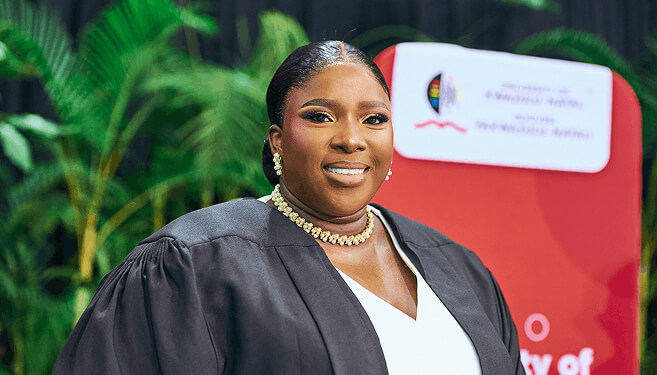
Committee Coordinator for the Health Portfolio Committee at the KwaZulu-Natal Legislature, Ms Nomakhwezi Ntshele, has earned a Master of Commerce in Leadership Studies from the University of KwaZulu-Natal (UKZN) with her dissertation: ‘Exploring Gender Roles and the Deprivation of Women in Traditional Leadership: A Study of KwaZulu-Natal’.
Ntshele hopes her research will encourage policymakers, traditional leaders and communities to move beyond numerical representation towards genuine inclusion where women are not simply present, but are heard, trusted and recognised as legitimate holders of authority.
The study investigates whether women are merely represented in traditional leadership structures, or genuinely empowered to lead, influence decisions and shape their communities.
Ntshele’s interest in the subject was sparked by the suggested gap between South Africa’s commitment to gender equality and the lived experiences of women in traditional leadership.
The research found that although women were formally represented in traditional councils, their presence did not necessarily translate into meaningful influence over agendas, deliberations and consequential decisions.
“Representation cannot be measured by presence alone. Substantive participation requires women to have access to information, decision-making, leadership responsibilities and the ability to influence outcomes,” Ntshele said.
The study identified several barriers preventing women from meaningful participation which included patrilineal succession, marriage-related expectations, informal gatekeeping, unequal scrutiny and the dual burden of leadership and domestic responsibilities. Also in the findings, women were often associated primarily with welfare and caregiving roles, while matters relating to land, succession, resources and strategic governance remained predominantly male-dominated.
The research also shows that younger and more educated community members are more accepting of women in leadership roles, while progressive traditional leaders and visible examples of effective women leaders, are helping to challenge the perception that authority is inherently male.
In Ntshele’s research, Zulu culture is not portrayed as inherently oppressive towards women, but rather highlights how patriarchal interpretations and institutional practices can evolve and that cultural identity and gender equality need not be competing principles.
Although her study received gatekeepers’ approval in 2020, Ntshele said completing the degree while working and navigating professional challenges, disappointment, exclusion and painful personal loss had required immense perseverance.
However, her supervisor, Professor Bibi Chummun’s, patience, academic rigour, mentorship and belief in her abilities had not only helped her to persevere but allowed her to grow into a confident researcher.
Pleased with Ntshele’s achievement Chummun said: “I congratulate Nomakhwezi on this significant achievement and commend her for producing research that is academically relevant while remaining closely connected to the realities of communities and leadership in KwaZulu-Natal. I have no doubt that this milestone marks the beginning of an even greater contribution to scholarship and leadership practice.”
Ntshele dedicated her achievement to her mother, whose 70th birthday had made the academic milestone particularly meaningful. “My mother’s love, sacrifices, prayers and unwavering belief sustained me through some of the most difficult moments of my journey.”
Paying tribute to the late community leader and politician, Dr Ntuthuko Mahlaba, Ntshele said his belief in her potential and the opportunities he created had significantly influenced her professional and academic achievements.
The degree had also deepened her understanding of leadership as a responsibility grounded in inclusion, accountability and service and it had taught her that resilience is not the absence of difficulty, but the courage to continue regardless.
“I fell, I struggled, I grieved, I started again and I finished. I am proud of the qualification, but even more grateful for the person I became through the process,” she said.
Words: Hazel Langa
Photograph: Sethu Dlamini