

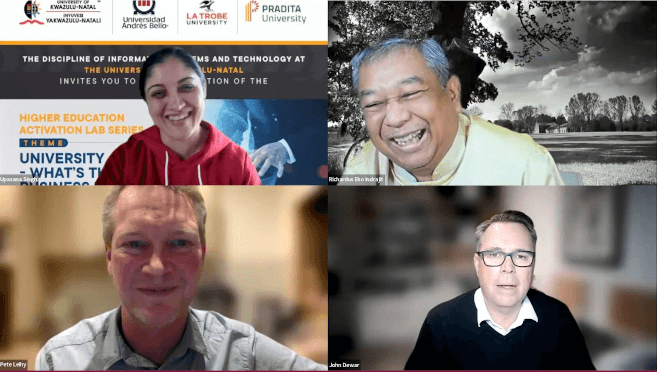
The university 4.0 business model was under the microscope at the third session of the Higher Education Activation Lab (HEAL) series hosted by UKZN’s School of Management, Information Technology and Governance’s Discipline of Information Systems and Technology (IS&T).
Unpacked at the virtual event was how vital the business model was for academic institutions wanting to achieve financial stability and support their educational missions thus enabling investments in research, academics and infrastructure so crucial for the provision of quality education.
The webinar, part of an ongoing series aimed at exploring the emerging business model of university 4.0 and the crucial transitioning from conceptualisation to practical implementation, was facilitated by IS&T Academic Leader Dr Upasana Singh and featured the following panellists:
- Vice-Chancellor and President of Australia’s La Trobe University, Professor John Dewar
- Professor Pete Leihy of the Universidad Andrés Bello in Chile
- Professor of Computer Science and Information Systems at Pradita University, Professor Richardus Eko Indrajit
Speaking on how the COVID-19 pandemic has forced Higher Education Institutions to rethink their business models especially when it comes to digital transformation and innovation, Dewar said the demand of learning offered in multiple modes was a key ingredient for university 4.0.
‘This offers students a choice to customise their learning experience at any stage of their study,’ he said. ‘The COVID-19 pandemic has accelerated the acceptance and adoption of modern university practices, and even before the pandemic, there were mounting pressures on the standard model of Higher Education. These pressures stem from various factors, including the evolving nature of the world of work, the profound influence of technology in education, government and societal expectations towards Higher Education and its graduates.’
Leihy said master’s degrees were viewed as macro credentials for their comprehensive academic nature, explaining that higher learning institutions needed to embrace macro credentialing to offer candidates the flexibility of obtaining accreditation for their knowledge, skills and competencies during their studies.
He said an advantage of online master’s degrees was the convenience of flexibility, accessibility, and global options.
Eko Indrajit shared insights on the challenges of limited resources faced by Indonesia and how they had developed the Indonesia Cyber Education Institute (ICE Institute), a digital marketplace for quality online courses which reduced the digital divide in Indonesia.
‘The primary objective of the ICE institute is to ensure the delivery of high-quality education while maintaining the standards and excellence of online learning and distance education services. The hope is that this initiative can help solve problems of disparity and inequality,’ he said.
Drawing on the information shared in the series, Singh said the HEAL presentations provided an important eye-opening platform where Higher Education Institutions from all over the world could reflect and share their experiences for universities of the future.
Words: Ongeziwe Mbuthuma
Photographs: Supplied