

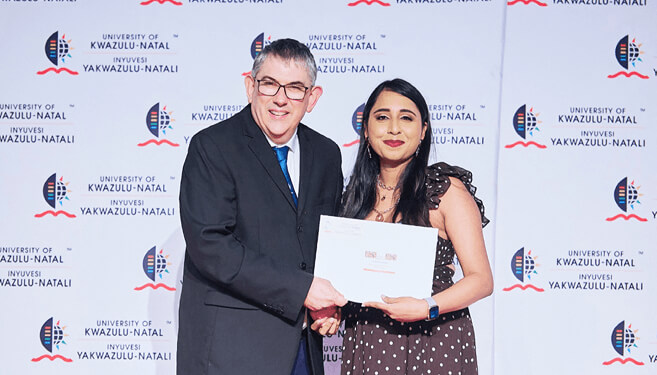
Researcher and educator, Ms Kelisha Pandaram – whose achievements have been recognised both locally and internationally – is the recipient of the University of KwaZulu-Natal’s (UKZN) Doctoral Research Scholarship supporting her investigations into marketing, artificial intelligence (AI) and emerging technologies.
Currently pursuing a PhD in Management, her academic journey at UKZN began with a Bachelor of Commerce Honours degree in Marketing Management summa cum laude, followed by a cum laude Master of Commerce in Marketing qualification and a postgraduate Certificate in Education cum laude. Her academic excellence later earned her the Emma Smith Overseas Scholarship, which supported her postgraduate studies at the University of Edinburgh in Scotland.
“I am particularly interested in the transition towards what is increasingly described as the Fifth Industrial Revolution (5IR), a future in which technological advancement is considered alongside human-centred values, creativity, ethics and societal well-being,” she says.
She completed a Master of Science in Marketing with Merit qualification at Edinburgh University, achieving a distinction for her dissertation. During her time at the University, she made history as the first South African recipient of the prestigious Principal’s Medal. She also received the Heart of Edinburgh Award, Sustainability Changemaker Award, Global Employability Award and Global Work Award.
Beyond these achievements, Pandaram has continued to demonstrate leadership and creativity through initiatives such as founding the Edinburgh Hikers Group, contributing as an author and poet to the University of Edinburgh Psychology Magazine and being recognised through various academic, leadership and innovation programmes.
Her doctoral research reflects her interest in how technology is changing society and the marketing landscape. She is particularly interested in AI and the emerging Fifth Industrial Revolution (5IR), which places greater emphasis on balancing technological advancement with human values, ethics and social wellbeing.
Pandaram believes researchers have an important role to play in understanding and shaping technological change, particularly from an African perspective.
“I wanted my doctoral research to engage with this changing landscape while contributing knowledge from a South African perspective. What motivates me most is the opportunity to conduct academically rigorous research that remains relevant to the Global North and South, beyond the University,” she says.
Her academic journey, however, has not been without challenges. Financial uncertainty, demanding workloads, personal sacrifices and the pressures of research have tested her resilience.
“One of the most important lessons I have learned is that resilience does not mean never struggling – it means continuing to move forward while learning from the difficult seasons of your life. Academia itself can also be humbling because research requires you to become comfortable with criticism; I have learned not to see that as failure but as part of becoming a stronger researcher and thinker.”
For Pandaram, this scholarship means more than just financial support; rather recognition of her potential and responsibility to produce meaningful research. The achievement also carries special significance as she will be the first person in her lineage to graduate with a doctorate.
As she continues her doctoral studies, Pandaram remains committed to using education, research and innovation to contribute to society.
“I want young South Africans to see themselves as recipients of knowledge and technologies developed elsewhere, and as scholars, authors, researchers, innovators, entrepreneurs and creators of knowledge capable of contributing ideas to the world,” she said.
“As we move further into an age shaped by artificial intelligence and towards the possibilities associated with the 5IR, I believe Africa’s young people should not merely witness technological evolution from the sidelines. We should be among those researching it, questioning it, creating it and determining how it can be used to build a more human-centred future,” she added.
Words: Ayanda Radebe
Photograph: Sethu Dlamini