

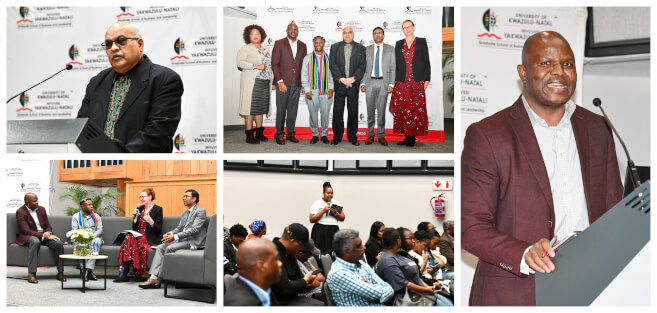
The Graduate School of Business and Leadership (GSB&L) at the University of KwaZulu-Natal (UKZN) recently hosted a panel discussion titled ‘Digital Transformation in India and KwaZulu-Natal, South Africa’, bringing together government leaders, industry experts, academics and postgraduate students to explore how digital innovation is reshaping economies and societies.
Facilitated by Professor Purshottama Reddy, the discussion examined how digitalisation is transforming the way governments, businesses and communities operate, creating opportunities to improve efficiency, accessibility and innovation. The session explored the digital transformation journeys of India and South Africa, highlighting key opportunities, challenges and lessons that can support sustainable economic growth and technological advancement.
Delivering the welcome address, Dean and Head of the GSB&L Professor Serestina Viriri highlighted the School’s commitment to creating platforms that expose current and future business leaders to emerging global trends. He noted that, in the era of generative artificial intelligence, organisations must rethink how they respond to rapidly evolving technologies. The School, he added, remains committed to engaging leaders at the forefront of digital transformation to help shape business thinking and leadership.
The panel featured distinguished experts from government and industry, each selected for their extensive experience in digital governance, innovation and public policy.
Indian Consul General in Durban, Mr Niteen Subhash Yeola, reflected on the strong partnership between India and South Africa, emphasising that both countries have much to learn from one another.
He noted that KwaZulu-Natal is embracing innovation across sectors such as smart manufacturing, fintech, logistics, Higher Education and digital entrepreneurship, while India’s digital transformation journey demonstrates the importance of building technology that is inclusive, affordable, interoperable, scalable and citizen-centred.
“The real measure of digital transformation is not the number of apps we build. It is the number of lives we improve… When innovation is combined with inclusion, scale and trust, technology becomes a powerful instrument for development,” said Yeola.
Chief Director for Research and Policy in the KwaZulu-Natal Office of the Premier, Ms Helen North, outlined the province’s Digital Transformation Strategy, which is guided by 10 strategic pillars for the 2025-2030 period. These include connectivity, digital skills, information security, process automation, systems integration, digitisation, inclusive economic growth, social wage, capable ethical and developmental state, as well as smart KwaZulu-Natal.
She highlighted several initiatives currently underway, including the development of integrated digital systems, AI-powered performance analysis tools, e-recruitment platforms and knowledge management systems. Through partnerships with the private sector, digital connectivity is also being expanded to rural communities, clinics, schools and police stations.
“The province is no longer simply talking about digital transformation – it is building it. Digital transformation is no longer an ICT initiative but a provincial governance and public service reform programme requiring executive leadership, cross-departmental collaboration and shared accountability,” North said.
Providing a municipal perspective, Director for Strategy and Integrated Development Planning at eThekwini Municipality Mr Bongumusa Zondo outlined how the municipality has progressively strengthened its digital transformation agenda through evidence-based planning, integrated data systems, data governance and artificial intelligence-enabled service delivery. He highlighted initiatives such as the Strategic Hub, the eThekwini App, digital citizen engagement platforms and AI-driven municipal services, while outlining future opportunities for collaboration through a proposed BRICS Urban Innovation and Learning Network involving municipalities and universities.
“eThekwini’s journey demonstrates that digital transformation is not merely about technology. It is about creating an ecosystem where data, research, innovation and partnerships converge to improve the lives of citizens, and through partnerships with various entities and support from institutions such as UKZN we can co-create the future of intelligent, resilient and inclusive cities,” said Zondo.
The discussion was followed by an interactive question-and-answer session, providing delegates with an opportunity to engage the panel on key issues relating to digital transformation, innovation, governance and future collaboration.
The event reinforced the School’s commitment to facilitating discussions aligned with emerging business trends, digital innovation and the rapidly evolving technological landscape.
Words: Ayanda Radebe
Photographs: Albert Hirasen