

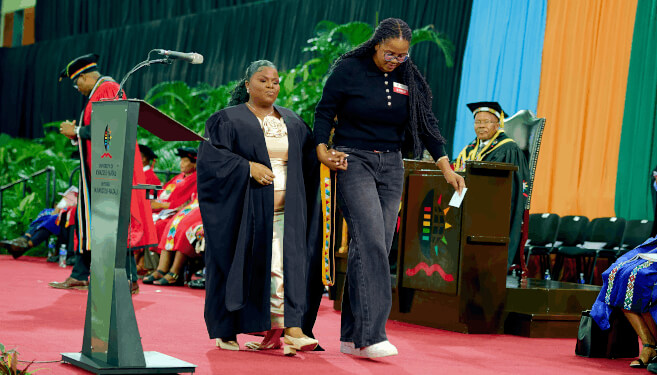
Ms Nandipha Sothiya (39), who is blind, has graduated with a Postgraduate Diploma in Human Resource Management – an achievement that also shines a light on the structural barriers that students with disabilities continue to face in accessing Higher Education.
Born blind, Sothiya completed the qualification while working as an educator and raising three young children aged ten, seven and four. She situates her achievement within a broader call for institutions and workplaces to do more to create the conditions in which persons with disabilities can thrive.
“As a woman living with a disability, I am driven by the need to challenge limitations and break barriers,” she said. “I wanted to prove to myself, my children and others in similar situations that it is possible to achieve goals regardless of challenges faced. Completing this qualification gave me a renewed sense of confidence and self-belief.”
The barriers Sothiya refers to are not personal shortcomings, but systemic ones- inaccessible study materials and environments not designed with persons with disabilities in mind. Her determination to succeed despite these gaps should prompt institutions to ask what structural changes are needed, rather than placing the burden of access on individual students.
Currently working as an educator in Pietermaritzburg, Sothiya is passionate about Human Resource Management as a means of building genuinely inclusive environments for teaching and learning.
“I am committed to education and enjoy working with learners, especially in creating supportive and inclusive environments,” said Sothiya. “I have always been interested in understanding how organisations function and how people can be supported and developed within the workplace. Pursuing a qualification in Human Resource Management allowed me to expand my knowledge beyond the classroom and explore new opportunities.”
Studying as a person who is blind, Sothiya had to source alternative ways of accessing study materials, relying on assistive technologies and additional support that were not always available as standard. This points to a wider institutional responsibility: accessible formats and proactive support should be the default, rather than something students with disabilities must individually request.
Sothiya is encouraging other persons with disabilities, especially women, not to give up on their goals, while also making clear that the challenges she faced were not inherent to her disability, but produced by systems that have yet to fully include persons with disabilities.
“This experience taught me that while my disability may require me to approach things differently, it does not limit my ability to succeed. My future plans include growing both within the education sector and exploring opportunities in Human Resource Management. I am especially interested in contributing to more inclusive workplaces and advocating for equal opportunities for people with disabilities,” she added.
Her advocacy for equal opportunities and inclusive workplaces reflects the social model of disability: that it is not impairment itself, but the failure of environments and systems to accommodate difference, that creates disadvantage. Sothiya’s graduation is a personal milestone – and a challenge to institutions to make such milestones accessible to all.
Words: Thandiwe Jumo
Photograph: Sethu Dlamini