

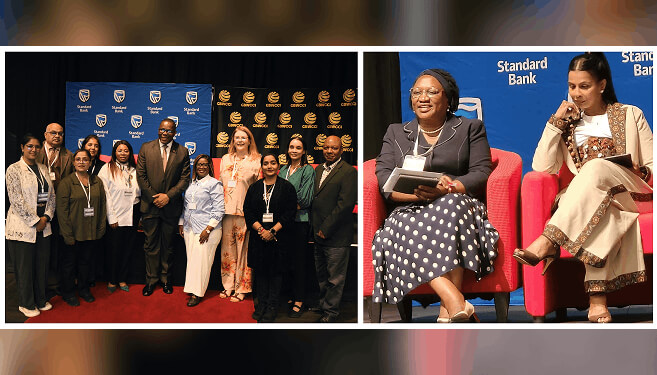
About 15 staff members from the University of KwaZulu-Natal’s (UKZN) College of Law and Management Studies (CLMS) attended the Global Business Women’s Chamber of Commerce and Industry (GBWCCI) Workforce Summit 2026 held at the Durban International Convention Centre (ICC) under the theme: ‘Tomorrow’s Workforce: Bridging the Gap’.
The summit drew delegates from government, industry, organised business, schooling and Higher Education for a full day of dialogue on how South Africa prepares young people for a rapidly changing world of work. Delegates heard from eThekwini Mayor, Councillor Cyril Xaba; Deputy Minister of Higher Education and Training, Dr Nomusa Dube-Ncube; GBWCCI President, Ms Fawzia Peer; and GBWCCI Deputy President, Dr Thandi Ngxongo, alongside speakers, panellists and moderators drawn from business, universities, and the public sector.
UKZN was represented on the summit’s third panel, ‘Future-Ready and Inclusive – Closing the Workforce Skills Gap for All’, by Professor Betty Mubangizi, *National Research Foundation / South African Research Chairs Initiative (NRF/SARChI) Chair in Sustainable Rural Livelihoods. She argued that workforce and economic inclusion require a spatial lens, because gender cannot be separated from the opportunities and constraints associated with place. “Rural women must be recognised not merely as vulnerable beneficiaries, but as entrepreneurs, knowledge holders and ecological stewards. We must build their capabilities where they live and connect their enterprises to skills, finance, technology and wider markets so that mobility becomes a choice rather than a consequence of exclusion,” she said.
Discussions across the day returned repeatedly to the impact of artificial intelligence (AI) and digital advancement on the nature of work, persistent digital divides and other societal barriers, the skills employers are actively seeking, graduate employability, and the relevance of the curriculum. Speakers weighed the jobs likely to disappear against those yet to emerge, and considered the place of entrepreneurship and the importance of supporting women across these spaces. It became clear that Higher Education is tied to a much broader ecosystem spanning basic education, industry, entrepreneurship, technology and workforce development and that no single stakeholder can prepare tomorrow’s workforce on its own.
Attending as the School of Commerce Internationalisation representative, Professor Thea van der Westhuizen said the discussions had direct implications for how UKZN positions its graduates in a global labour market. “Preparing tomorrow’s workforce is a systemic task that connects schools, universities, employers, government and communities, and increasingly it is an international one as well. Our graduates will compete and collaborate in labour markets shaped well beyond our borders. The partnerships we build with universities abroad, the mobility opportunities we create for staff and students, and the way we bring global perspectives into the curriculum are all part of bridging this gap,” she said.
The programme concluded with a Summit Action Lab, where the GBWCCI presented an Action Plan and Declaration outlining commitments for ongoing collaboration between the chamber, Higher Education Institutions, and industry partners.
*Department of Science, Technology and Innovation (DSTI)/National Research Foundation (NRF) South African Research Chairs Initiative (SARChI) (a strategic intervention of the South African government designed to attract and retain research excellence and innovation at South African public universities, Research Councils and National Research Facilities).
Words: Thea van der Westhuizen, Betty Mubangizi and Purshottama Reddy
Photographs: Supplied