

Research by University of KwaZulu-Natal (UKZN) Economics lecturer and artificial intelligence (AI) Champion, Ms Janet Bruce-Brand, is contributing to growing international conversations about AI, ethics, Indigenous Knowledge, and the future of Higher Education.
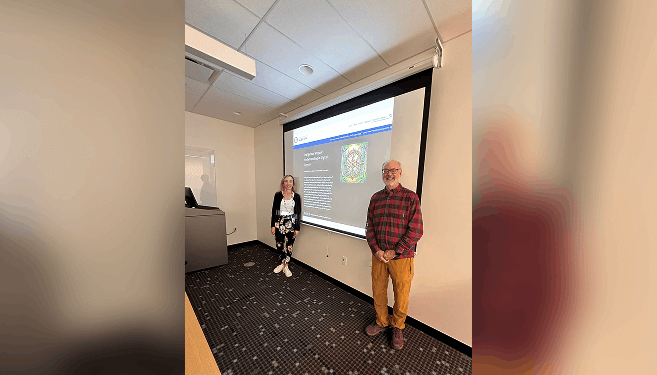
Following an academic collaboration that began with her presentation at the 2025 International Council for Open and Distance Education (ICDE) conference in New Zealand, Bruce-Brand recently travelled to Canada for the launch of the book, Indigenous Ways of Understanding in Digital Spaces.
Her talk, which explored how the African philosophy of Ubuntu can shape approaches to AI, open learning, and Indigenous Knowledge Systems, caught the attention of Mount Royal University’s Professor Norman Vaughan, who invited her to contribute a chapter. This partnership has since grown into discussions about broader future engagements between Mount Royal University and UKZN.
Bruce-Brand said the international experience highlighted the importance of ensuring that African perspectives are represented in global discussions about AI. “There is a growing international conversation about how AI will transform education, but it is equally important that African perspectives help shape that conversation. Ubuntu encourages us to ask not only what AI can do, but whose knowledge, languages and values are represented in the systems we increasingly rely upon,” she said.
Her chapter, Reimagining Education Through an Ubuntu Lens: Artificial Intelligence, Open Learning, and Indigenous Knowledge in a Global Context, examines AI through issues including dignity, linguistic justice, epistemic justice, community authority and governance. Bruce-Brand cautioned that AI technologies are not necessarily neutral. Systems developed using predominantly Global North datasets, languages, and design priorities may not adequately reflect African educational contexts, languages and knowledge traditions. She also highlights concerns around algorithmic bias, including the potential for AI tools to produce different outcomes for different groups.
“Access to AI does not automatically mean equitable participation. We need to ask whether a system understands the language, context and experiences of the students using it, whether bias can be identified and challenged, and whether students have a meaningful way to question decisions made through technology,” she said.
Her international engagements complement work already underway at UKZN. Bruce-Brand serves on the University’s AI Task Team and has contributed to the development of UKZN’s Senate-approved Generative AI Academic Guidelines, particularly around ethical integration, academic integrity and capacity-building.
The New Zealand and Canadian engagements demonstrate the growing international reach of UKZN scholarship and provide an opportunity to showcase the University’s contribution to debates about responsible AI. “African universities should not simply be consumers of AI systems and ideas developed elsewhere. We have an important contribution to make to how ethical AI is understood globally, particularly around questions of Ubuntu, language, inequality, Indigenous knowledge and educational justice,” Bruce-Brand said.
Professor Bomi Nomlala, UKZN College Dean of Teaching and Learning, commended Bruce-Brand for flying the UKZN flag on an international stage. “As universities worldwide navigate the opportunities and challenges presented by AI, Janet’s work underscores the importance of ensuring that technological innovation remains ethical, inclusive and responsive to the diverse communities served by Higher Education.”
Words: NdabaOnline
Photograph: Supplied