

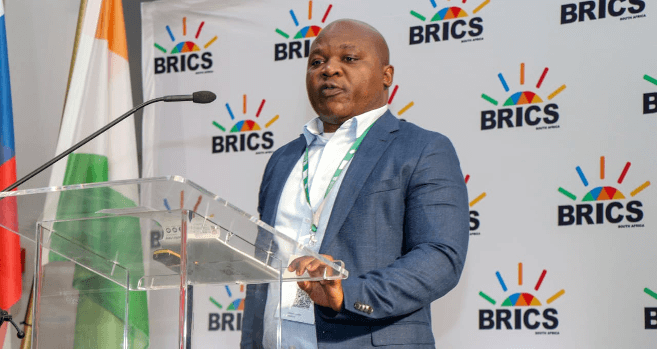
The recently concluded BRICS (Brazil, Russia, India, China and South Africa) conference on Governance and Public Administration reform hosted by the National School of Government saw the participation of a Master of Public Administration alumnus from the University of KwaZulu-Natal (UKZN), Mr Thobani Ngcobo, presenting a thought-provoking paper.
Ngcobo is an accomplished development practitioner, researcher and communications strategist who has spent the last five years navigating Land and Public Administration. He has served in various roles in government, spanning Land Administration, Development Cooperation, Stakeholder Management, Communications and Research.
As part of his ground-breaking research, Ngcobo presented his results along with Professor Fayth Ruffin from UKZN’s School of Management, Information Technology, and Governance (SMIG), which analysed both empirical and non-empirical data from South Africa, Brazil, and India in a cross-case study manner. The study aimed to answer crucial research questions related to public administration and its impact on the BRICS nations.
His research paper employed a unique approach by combining empirical and non-empirical data to conduct an in-depth cross-case study analysis. Empirical data, derived from South Africa, provided concrete evidence to answer the research questions, while non-empirical data collected from Brazil and India added a broader perspective to draw meaningful conclusions.
Speaking on his presentation, Ngcobo said, ‘The conference paper questions how implementation processes and procedures for rural development, with specific reference to agriculture, inform community sustainability, foster social cohesion and advance market intelligence in selected BRICS countries. The findings show that policy implementation remains an issue where there is a disconnection between rural landowners or land-holders and government officials. Social cohesion is supported by indigenous knowledge systems. Findings reveal innovations including rural development strategies that are multifaceted and homegrown.’
Ngcobo’s participation and presentation of the trio’s thought-provoking research paper at the conference has garnered significant recognition within the academic community. In recognition of their collaborative work, Ruffin said: ‘I was very excited when Thobani contacted me about us shaping some aspect of his dissertation into a presentation. This of course has enabled us to move forward with a paper for publication as well as a policy brief for government officials who requested more information about our presentation at the BRICS conference. We were able to shape his empirical research which was originally about South Africa, into a regional context by bringing in other countries in the BRICS geo-political block through secondary data.’
The study yields evidence of skills needed by local public managers in all three countries to facilitate agricultural land development and local/regional social cohesion among the multi-level actors. Moreover, recommendations highlight how to put the findings into practice so as to build the collective and intellectual leadership of BRICS countries.
The presentation shed light on public administration practices within the BRICS nations. The research findings have significant implications for policymakers and practitioners, offering valuable insights and potential areas for future administrative reforms. The alumnus’s participation in this prestigious conference has not only contributed to the academic community, but also enhanced the reputation of UKZN as a research institution.
Words: Sibonginkosi Mabika
Photograph: Supplied